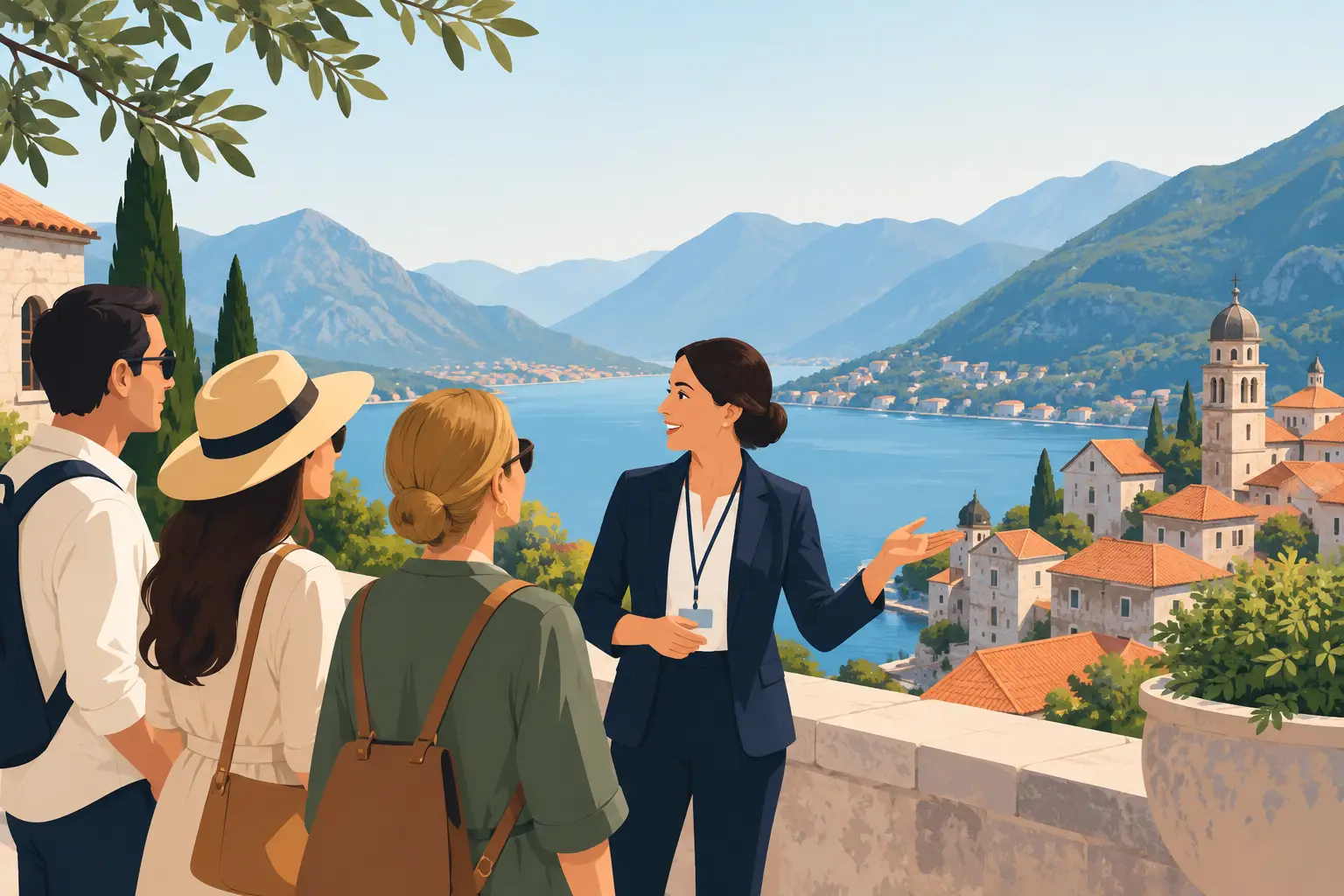
A guide can transform a private walk through Dubrovnik’s stone lanes, a wine tasting in Istria or a journey between Sarajevo, Kotor and Belgrade. Yet finding multilingual Balkan guides is not simply a matter of choosing someone who speaks the guest’s language. For premium travellers and travel professionals, the right guide must bring together cultural authority, emotional intelligence, polished hosting and an instinct for the practical details that keep a multi-country journey running beautifully.
Across South-East Europe, languages, histories and travel rhythms can change within a few hours on the road. That richness is precisely what makes the Balkans so rewarding. It is also why guide selection deserves the same care as choosing a hotel, yacht, driver or restaurant table with a view.
Finding multilingual Balkan guides with real destination depth
Fluency is the starting point, not the finish line. A guide may speak excellent English, French, German, Spanish or Italian, but a memorable experience depends on how naturally they communicate with the particular guests in front of them. The best guides know when to share the fascinating detail behind a Roman ruin and when to leave space for a couple to absorb the view. They can speak confidently to an art lover, entertain a multigenerational family and adjust their pace for guests who would rather linger over coffee than race through a checklist of sights.
This matters especially in the Balkans, where historical context needs sensitivity as well as knowledge. A guide discussing Sarajevo’s Austro-Hungarian architecture, the legacy of the former Yugoslavia or the cultural layers of Mostar should be accurate, balanced and attuned to the group. Guests deserve meaningful interpretation rather than rehearsed facts or oversimplified narratives.
Local depth also goes beyond headline landmarks. In Split, this may mean knowing which corners of Diocletian’s Palace are quietest early in the morning. In Ljubljana, it may be a thoughtful introduction to the city’s design culture. In Montenegro, it could be arranging a gentle walk above the Bay of Kotor with a perspective few day visitors see. The guide is not there merely to recite history. They are there to make a destination feel personal.
Language matching is more nuanced than it appears
Travel planners should be precise when discussing language requirements. “English-speaking” may be sufficient for a corporate incentive group, while a family travelling from France may feel more relaxed with a French-speaking guide who can explain regional cuisine and local customs in their first language. For some guests, a bilingual guide is ideal. For others, particularly on a complex itinerary with several specialist visits, separate guides with deeper local expertise may offer the stronger result.
It also helps to distinguish between conversational ability and professional guiding ability. A fluent speaker may be a superb host at dinner but not licensed or experienced enough to lead a detailed heritage visit. Equally, a highly qualified guide may not be the best personality match for a celebratory group looking for warmth, spontaneity and a relaxed holiday atmosphere.
The right decision depends on the itinerary. A three-night city break can often be enhanced by one exceptional guide who builds rapport quickly. A 14-day journey through Croatia, Slovenia, Bosnia and Herzegovina, Montenegro and Serbia requires careful continuity. Guests should feel looked after at every stage, while still benefiting from specialists who genuinely know each place.
Ask about guiding style, not just credentials
Credentials, licences and language certificates matter, particularly at protected heritage sites and museums. However, they cannot reveal how a guide manages the small moments that define service. Can they read a group’s energy after an early flight? Do they know how to accommodate a guest with limited mobility without making them feel conspicuous? Are they confident liaising with a restaurant, boat captain or hotel concierge when plans change?
A thoughtful briefing is invaluable. Share the group profile, interests, dietary requirements, walking preferences, key celebrations and any areas of particular sensitivity. A good local operator will then recommend a guide based on fit, rather than assigning whoever happens to be available.
Look for regional coordination, not isolated appointments
The Balkans should never be treated as a single, uniform destination. Each country has its own guiding regulations, languages, transport considerations and supplier relationships. A guide who is outstanding in Croatia may not be licensed to guide in Slovenia or Bosnia and Herzegovina. Border crossings, road conditions and local operating practices can also affect timing.
For travel professionals, this is where on-the-ground coordination makes the difference between an attractive itinerary on paper and an effortless guest experience. One trusted destination management partner can ensure that guides, drivers, hotels and experiences are briefed to the same standard, even as the journey crosses borders.
There is a trade-off to consider. Using one tour leader throughout a multi-country route can give guests welcome continuity and a familiar face. Bringing in local guides in each destination adds specialist insight and often stronger storytelling. The finest programmes frequently combine both: a knowledgeable host or tour leader for the overall journey, supported by carefully chosen local experts for city tours, wineries, national parks and cultural encounters.
This approach also creates flexibility. If weather affects a sailing day on the Adriatic, a private visit runs late or a border queue changes the arrival time, the team can revise the day intelligently. The guest should experience a beautifully paced holiday, not the mechanics behind it.
The qualities that distinguish exceptional guides
The strongest multilingual guides share a particular kind of discretion. They are engaging without being intrusive, informed without being overly formal, and capable of creating a sense of occasion without making the day feel staged. In luxury travel, guests often value the freedom to ask unexpected questions, pause for photographs or change direction because a café, gallery or market catches their attention.
They also understand the value of anticipation. A guide might arrange the most suitable entrance to avoid unnecessary steps, suggest a shaded terrace during the warmest part of the afternoon or time a coastal drive for the best light. These decisions may appear effortless to the guest, but they come from experience and close local knowledge.
For MICE groups and incentive programmes, additional skills become essential. Guides need confident group management, clear timing, familiarity with coach operations and the ability to work closely with event managers. They must keep a large group engaged while protecting the schedule, often across several languages. For a private family, by contrast, patience, adaptability and child-friendly storytelling may be the priorities.
Build guide selection into itinerary design
Guide availability should be considered early, especially for peak dates, major events and programmes requiring less common language combinations. The most sought-after professionals are often reserved well in advance for the summer season, festive departures and high-profile conferences. Early planning allows the itinerary to be shaped around the right people, rather than settling for a functional replacement later.
It is equally wise to plan the guide’s role alongside transport and experience design. A guide who joins guests in a luxury vehicle can offer context between stops and respond to spontaneous requests. A walking specialist may be perfect for a compact historic centre but not needed for a relaxed island day with a private skipper. There is no universal formula, only the most appropriate level of service for each day.
At Perfecta Travel, guide matching sits within a wider approach to itinerary management: hand-picked local experts, private transport, carefully timed experiences and round-the-clock operational support. It means travel designers can offer the romance of the region with the confidence that every moving part has been considered.
Questions worth asking before confirming a guide
Before a programme is finalised, confirm the guide’s professional language level, licence coverage and experience with the relevant guest profile. Ask whether they have led similar itineraries, whether they can accommodate specific mobility or dietary needs, and how they handle last-minute adjustments. For group travel, establish maximum group sizes, use of audio equipment and the plan for split activities or free time.
It is also worth asking what the guide is genuinely passionate about. A history specialist, food-focused storyteller, nature guide or art historian can add an entirely different dimension to an itinerary. Matching that passion to the traveller’s interests is often what turns an excellent day into the story guests repeat long after they return home.
The Balkans reward curiosity. With the right multilingual guide, every border crossing becomes a new chapter, every meal carries a local story, and even a quiet lane or roadside viewpoint can become part of an unforgettable journey.