A late ferry change in the Split archipelago, a private guide needed at short notice in Dubrovnik, or a guest arriving with a lost passport can quickly show where responsibility really sits. The Croatia DMC vs tour operator question is therefore not simply about industry terminology. It is about choosing the right structure to create exceptional holidays while protecting the traveller experience when plans need expert local attention.
For travel designers, luxury agencies, concierge teams and group planners, both partners have a valuable role. The strongest programmes often depend on both. The distinction lies in who owns the customer relationship and product strategy, and who has the local network, contracting knowledge and operational presence to make every moving part work on the ground.
Croatia DMC vs tour operator: the core difference
A tour operator typically creates, packages and sells travel products to consumers or through the trade. They may combine flights, accommodation, transport and experiences under their own brand, establish pricing and terms, and remain the principal point of contact for the traveller or selling agent. Some tour operators focus on a single destination; others sell a broad portfolio across Europe and beyond.
A destination management company, or DMC, is the destination-based specialist. Its work is centred on local product development, supplier management, itinerary design and in-country delivery. A Croatia DMC may support a tour operator behind the scenes, or work directly with an agency, corporate planner or private client to create a programme from first idea to final departure.
The titles can overlap. A locally based operator may package and sell holidays, while an international tour operator may maintain an excellent Croatian office and contract directly with suppliers. Rather than relying on the label alone, assess the actual team, destination coverage, contracting model and service available when guests are travelling.
What a tour operator brings to the journey
A tour operator is often the right partner when an agency needs a ready-to-sell, clearly priced product with established booking processes. It can offer a curated collection of departures, accommodation categories and touring styles, particularly for clients whose priorities are straightforward and whose dates are fixed.
For the traveller, that can mean a convenient single booking and a familiar brand relationship. For the agency, it can reduce administration, especially where the operator already has commercial agreements that fit the brief.
The trade-off is flexibility. A brochure-style programme may include excellent hotels and popular excursions, but it may not be built around a particular family’s pace, a client’s interest in Croatian wine, a yacht charter with a preferred crew, or a multi-generational group needing varied room types and private touring. Customisation is possible with many operators, but its depth depends on their local buying power and the time they can devote to individual requests.
A tour operator also may not have staff in every destination on the itinerary. This matters when a holiday moves beyond a single hotel stay into private transfers, island crossings, restaurant reservations, guide scheduling and border arrangements across the Balkans.
What a Croatia DMC manages differently
A DMC begins with the destination rather than a fixed package. It knows which heritage hotels feel intimate rather than merely fashionable, which konoba serves regional cooking with genuine character, and when a headline attraction is best replaced by a quieter alternative. That knowledge is not only inspirational. It is operational.
In Croatia, logistics can be deceptively complex. Ferry and catamaran services are seasonal and weather-sensitive. Island accommodation has limited inventory during peak weeks. Historic city centres impose vehicle restrictions. A two-hour transfer on a map may become a very different experience on a busy summer Saturday. A capable local team designs around these realities before they affect the holiday.
A DMC also brings access to a wider supplier landscape. For a tailor-made itinerary, that might mean securing a private skipper for a Hvar-to-Vis day at sea, arranging a specialist guide for Diocletian’s Palace, or matching a family with an estate in Istria where food, space and privacy all feel right. For a MICE programme, it can mean coordinating gala venues, production, guest movements, branded experiences and contingency planning under one destination-led team.
The best DMCs do not simply pass bookings to local suppliers. They maintain quality standards, monitor service delivery and remain available throughout the programme. This is especially valuable for high-value journeys and complex groups, where a small disruption can affect many guests and the agency relationship behind them.
When local presence matters most
For a simple city break in Zagreb or a short coastal stay with standard transfers, a tour operator’s packaged offering may be all that is required. The proposition changes when the journey includes several regions, specific interests or a high expectation of personal service.
Consider a couple travelling from Dubrovnik through Montenegro and Bosnia and Herzegovina before continuing to Split and the islands. The itinerary involves different currencies, border timings, guide licences, hotel styles and transport routes. A local DMC can consider the journey as one connected experience, rather than a series of separate bookings. It can also advise honestly when an ambitious routing will feel rushed, even if it looks appealing on paper.
The same applies to private groups. A birthday celebration aboard a yacht, a family reunion across Dalmatia, or an incentive group needing a memorable opening night calls for more than room allocations. Guests need timings that feel effortless, hosts who understand the occasion, and a team prepared to solve the unexpected discreetly.
Who holds the commercial and operational responsibility?
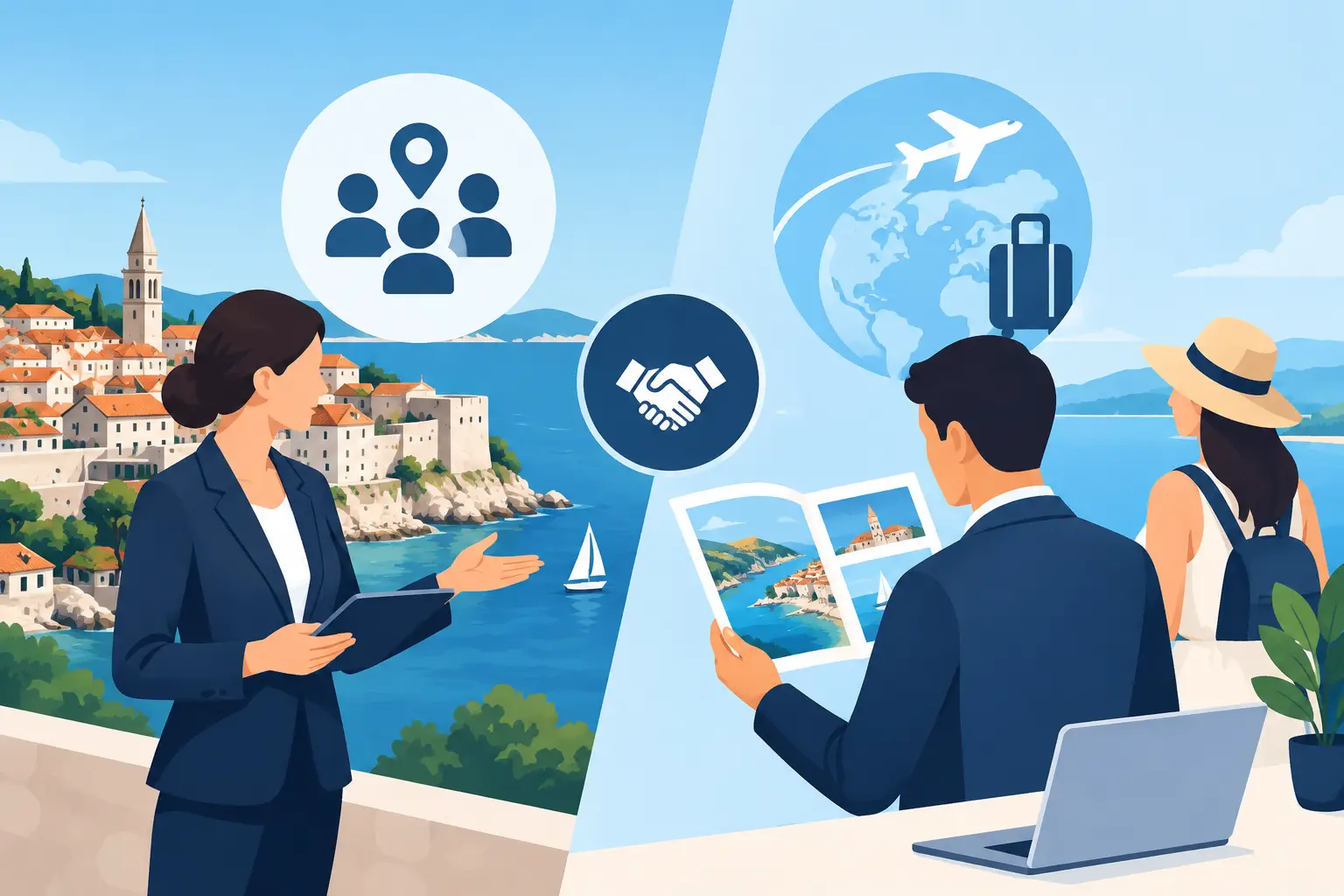
This is the question worth asking early. A tour operator may be the contracting party and customer-facing brand, while the DMC is the operational partner responsible for delivering ground arrangements. That is a normal and often highly effective arrangement, provided roles are clear.
Travel professionals should establish who confirms availability, who manages supplier payments, who communicates itinerary changes, and who handles an emergency outside office hours. They should also ask whether the local partner has appropriate liability insurance, multilingual consultants and direct relationships with the suppliers proposed.
Price deserves context too. A lower headline cost can be attractive, but it may omit the careful coordination that protects a premium holiday. Equally, a DMC is not automatically the most expensive choice. Strong local purchasing, sensible routing and accurate advice can prevent costly mistakes, unnecessary backtracking and disappointing compromises. Best value is the right balance of quality, access and dependable delivery.
Choosing the right partner for your client
Start with the programme rather than the category. If the brief is a familiar, fixed itinerary with clear inclusions, a tour operator may offer the most efficient route to confirmation. If the requirement is deeply personalised, involves several destinations, or needs specialist local knowledge and active support, a DMC is likely to add more value.
For many agencies, the ideal model is partnership rather than either-or. The tour operator provides the commercial framework, sales expertise and client relationship; the DMC provides destination intelligence, hand-picked services and in-country oversight. Together, they can give travellers the reassurance of a recognised booking partner alongside experiences that never feel standardised.
Perfecta Travel works in this space as a Croatia-based DMC for travel trade partners and discerning travellers, designing programmes from private Adriatic escapes to multi-country Balkan journeys. The value is not simply in arranging the components. It is in knowing how they belong together, and in having an experienced team ready when the destination asks for quick, informed decisions.
The most useful choice is the one that lets your client feel the magic of Croatia – a quiet morning among Korčula’s vineyards, a table overlooking the Adriatic, an ancient city after the crowds have gone – while a trusted team takes care of everything that makes those moments possible.