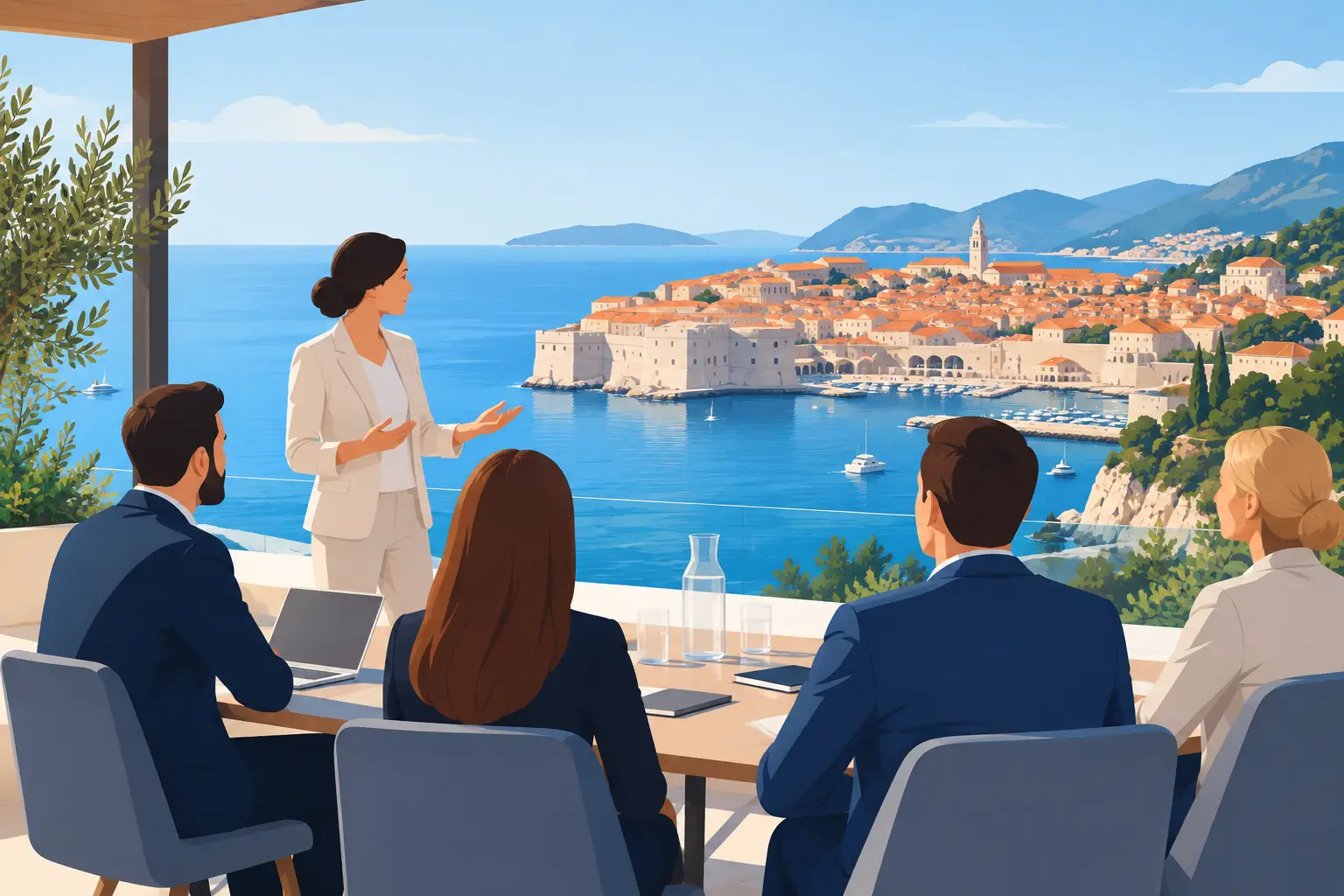
A board meeting in a historic Dubrovnik palace, a sunset reception aboard a private yacht, or a strategy session looking out across Istrian vineyards: MICE Croatia gives corporate gatherings a setting that delegates genuinely remember. For planners, the appeal is not simply beautiful scenery. It is the rare ability to combine high-calibre hotels, meaningful local experiences and carefully managed logistics within a compact, accessible destination.
Croatia rewards ambitious programmes, particularly when the brief calls for more than another city-centre conference. Its coastline, islands and historic towns create instant atmosphere, while Zagreb, Split, Dubrovnik and Istria offer the infrastructure needed for meetings, incentives, conferences and executive events. The most successful programmes respect the destination’s rhythms, choosing the right region, season and pace for the group.
Why MICE Croatia makes business travel feel special
Delegates are increasingly selective about the events they attend. A well-run agenda remains essential, but so does the experience around it: the welcome, the setting, the food and the stories people take home. Croatia brings these elements together naturally.
For incentive travel, this can mean sailing between islands after a morning conference, a private olive oil tasting in a family estate, or a chef-led dinner within the stone walls of a centuries-old town. For leadership teams, it may be a discreet villa retreat, a wine-country working lunch or a private guided walk that adds perspective to a demanding agenda. These are not distractions from the business purpose. Used thoughtfully, they create the space for stronger relationships, more candid conversations and shared memories.
The destination also suits a broad range of group sizes. Dubrovnik and Split have the international recognition and premium hotel stock for major incentives and conferences. Zagreb is a practical choice for meetings requiring reliable air access, formal conference facilities and an urban business atmosphere. Istria offers a gentler, gastronomic alternative for executive groups, while the islands can provide exceptional exclusivity for smaller incentives when transport is planned with care.
Choose the region around the event objective
Croatia is not one uniform MICE destination. The right location depends on whether the programme needs large-scale production capacity, privacy, easy arrivals or a strong experiential focus.
Dubrovnik for prestige and memorable arrivals
Dubrovnik has an immediate sense of occasion. Its UNESCO-listed Old Town, limestone streets and Adriatic views make it particularly compelling for senior leadership gatherings, reward trips and gala evenings. Premium hotels along the coast can support business sessions while offering private terraces, refined restaurants and sea-facing event spaces.
Its popularity is also the trade-off. During peak summer, accommodation, venue access and transfers require early commitment. Groups should consider May, June, September or October, when the weather is still inviting and the city has more room to breathe. A thoughtful programme might balance the Old Town’s grandeur with quieter experiences in Konavle, on the Elaphiti Islands or aboard a private vessel.
Split and the Dalmatian coast for energy and variety
Split combines a lively city atmosphere with direct access to the islands. It is an excellent base for groups that want choice: a modern conference environment, Roman heritage in Diocletian’s Palace, beach clubs, sailing and day trips to Hvar, Brač or Šolta.
This flexibility is valuable for mixed groups. Delegates who prefer culture can explore the historic centre, while more active participants might take to the water or hike coastal trails. However, island itineraries must be built around realistic sailing times and weather contingencies. A private boat creates freedom, but it does not remove the need for experienced maritime planning.
Istria for gastronomy, privacy and leadership retreats
Istria has a quieter form of luxury. Rolling hills, truffle-rich forests, medieval hill towns and acclaimed wineries create a strong setting for executive retreats, incentive groups and relationship-building events. It works especially well when food and wine are central to the brief.
A programme here can feel highly personal: a cellar dinner with a winemaker, a truffle hunt followed by a private lunch, or an evening in a characterful estate outside Rovinj or Motovun. It is less suited to a very large conference requiring extensive exhibition space, but for senior teams seeking privacy and substance, that is precisely its strength.
Zagreb for efficient meetings with character
For business-led events, Zagreb is often underestimated. Croatia’s capital has a growing collection of contemporary hotels and event venues, a walkable centre, excellent restaurants and straightforward transport links. It can be the practical anchor for a conference before a coastal incentive extension, or a complete destination for meetings where convenience matters most.
The city also adds personality without forcing a packed schedule. A private museum visit, coffee culture walk or chef’s-table dinner can make an otherwise formal programme feel considered and local.
Designing the programme beyond the conference room
The most effective corporate programmes do not fill every hour. They create a clear rhythm between business content, social connection and unstructured time. Croatia is particularly good at this because a striking experience can sit close to the hotel rather than requiring a full day of travel.
A morning plenary might be followed by a short transfer to a coastal restaurant for lunch. An afternoon at leisure can lead naturally into a sunset cruise and an intimate dinner. For longer incentives, a two-centre itinerary can pair Zagreb with the coast, or Dubrovnik with Montenegro, allowing guests to experience a wider sense of the Adriatic without excessive repacking.
Local authenticity matters, but it must be delivered to a standard appropriate for an international group. The best experiences are not generic performances of local culture. They are well-hosted encounters with people who are proud of their craft: winemakers, oyster farmers, chefs, artists, historians and skippers who understand both the place and the needs of discerning guests.
The operational details that protect the experience
A beautiful itinerary is only as strong as its delivery. Croatia’s geography offers extraordinary variety, yet it also creates practical considerations. Historic centres have vehicle restrictions, islands depend on marine conditions, and peak-season traffic can affect timings. These are manageable realities, not reasons to avoid the destination, provided they are anticipated from the outset.
For MICE Croatia programmes, planners should build transfer times conservatively, particularly around Dubrovnik and Split in summer. Group arrivals may need staggered welcome teams, dedicated luggage handling and clear airport-to-hotel communication. If a dinner is held inside a pedestrianised old town, the final approach should be planned for comfort, accessibility and guest flow rather than left to chance.
Venue selection requires equal care. A property may have a beautiful terrace but limited back-of-house access for production, or an inspiring island location but a finite room inventory. The right solution depends on the group’s priorities. A product launch may need technical capacity and branding opportunities; an incentive may value exclusivity and emotional impact more highly.
This is where a destination management partner earns its place. With 15 years of regional knowledge, multilingual on-site teams and access to trusted local suppliers, Perfecta Travel can coordinate accommodation, transport, production, experiences and guest support as one coherent programme. For travel trade partners, that single point of responsibility brings reassurance before arrival and calm problem-solving when plans need to adapt.
Timing Croatia well
The shoulder seasons are Croatia’s secret advantage for corporate travel. May and June offer long days, fresh energy and comfortable temperatures. September and October bring warm seas, harvest flavours and a more relaxed atmosphere after the summer peak. These months often offer the strongest balance of availability, value and experience.
July and August can still work beautifully for high-end incentive groups, especially where private yachts, exclusive venues and premium hotels are secured early. Yet planners should be candid about the higher costs, heavier visitor numbers and the importance of avoiding overambitious road schedules. Winter is best suited to Zagreb meetings and cultural programmes, while much of the coast becomes quieter and more limited outside the main season.
A successful event in Croatia should leave delegates feeling that they have been welcomed into a place, not simply moved through a schedule. Start with the business objective, choose the region that supports it, and let the country’s islands, heritage and generous table provide the magic around the meeting.